Saturday, April 12, 2008

Guernica

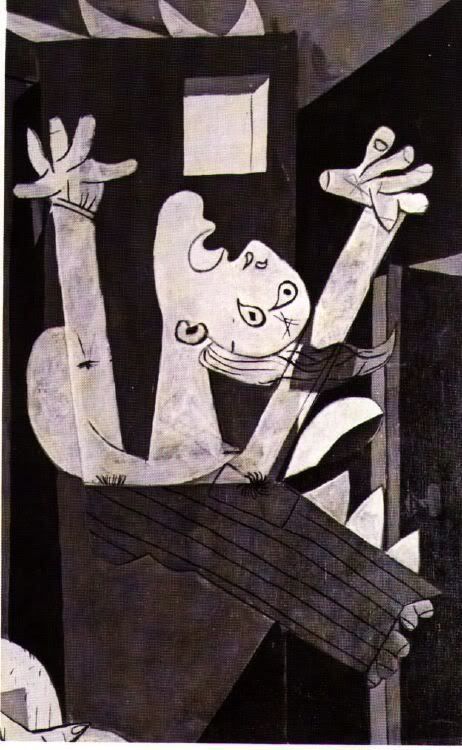
At first glance the painting Guernica displays one of Picasso’s signature styles, cubism. The black and white painting, in its original form a mural, depicts several white characters: round and curvy with exaggerated limbs and body formations. On the far left there is a woman screaming and holding a dead child. Beneath her is a wounded solider with a severed arm. There is another woman looking towards the light in the top center of the painting while the woman to the right is burning in a building. Alongside the characters are animals, a horse and a bull, also distorted and misshapen in form. The horse is pierced in the side by a spear and the bull looks dazed and lost as it slowly fades into the dark background. The crowded and smooth bodies of the characters and animals are intersected by dark, straight, and sharp angled lines. Ultimately, the cubist painting is an illustration of the bombings of Guernica, a time of war, loss, and suffering. Picasso successfully captures the true essence of war in his painting through the fusion and integration of artistic styles, cubism and futurism, and the rhetorical strategies of illustration and analogy as well as the rhetorical appeals of pathos and logos.


The artistic style that conveys and reflects the rhetorical appeal of logos is cubism. Cubism was explored and invented by Picasso in the early 20th century and depicts an alteration of perspectives: three dimensional viewpoints isolated, analyzed, and painted onto a two dimensional surface. It can also be defined as: “objects are broken up, analyzed, and re-assembled in an abstracted form…” The formulation of a new and innovative perspective achieved through a collage of old, manipulated perspectives characterizes cubism. This establishes an important aspect of cubism: the end of ambiguity. Art historian Ernst Gombrich described cubism as "the most radical attempt to stamp out ambiguity and to enforce one reading of the picture - that of a man-made construction…” A message or statement is clearly and best understood when one perspective is conveyed. This was one of Picasso’s primary goals in his painting Guernica. Picasso clearly reasons with his audience, through the presentation of perspective, that war is painful and full of suffering. He utilizes the rhetorical appeal of logos via illustration to establish a rational argument: that of anti-war. Picasso explains his perception and successful isolation of argument in his painting: “In the panel on which I am working, which I shall call Guernica, and in all my recent works of art, I clearly express my abhorrence of the military caste which has sunk Spain in an ocean of pain and death.”
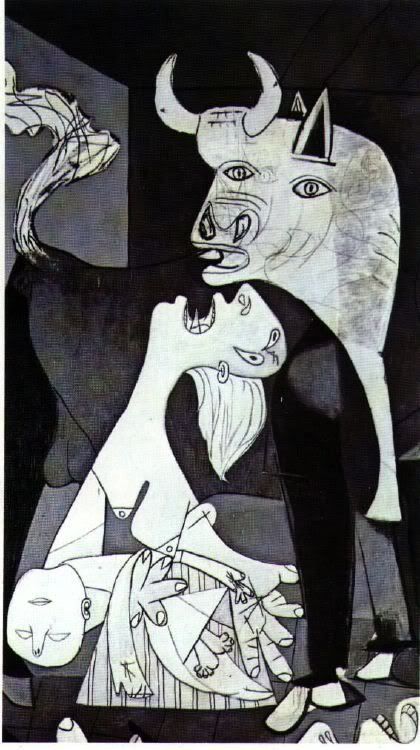


The figures in Picasso’s painting are clearly seen in pain, near death, or already dead. His use of illustration powerfully establishes his anti-war argument. The characters in the painting are contorted in agony. The woman on the far left of the painting is holding her dead child twisting her head back, weeping and mourning her loss. The horse in the center of the painting is twisted and tangled in pain as it is being pierced in the side by a spear. The curvy figures are intersected by sharp dark lines while the background and foreground overlap creating a sense of chaos and confusion. The woman on the far left disappears into the dark background—burning alive in a building. Only the head and upper appendages of fallen warrior can be detected in the painting as the rest of his body is enveloped in darkness. The bull is also swallowed into the dark background. These characters, in cubistic form, present one perspective, as well as an appeal to reason (anti-war) through the use of the rhetorical strategy illustration to establish the rhetorical appeal of logos.


Logical fallacies are also at work in the painting. Guernica was painted during the Spanish Civil War in the late 1930’s (fascism takeover of a peaceful republic). Picasso was asked to present a painting at the National Exposition in Paris for the world fair. Picasso lacked inspiration for the painting until he saw a photo in the newspaper of the Nazi bombing of Guernica in Spain. Outraged at the violence in his native country, he began the painting. The painting clearly depicts war—specifically the side of war involving mass destruction, loss, and suffering—and reduces the argument to an extreme: the logical fallacy of the either-or argument. Only one side, one perspective, is depicted in the painting. This painting later became one of the most famous anti-war sentiments and propaganda icons of all time.
Picasso’s powerful and moving icon, Guernica, incorporates another artistic style: futurism. Futurism is close in technique and style to cubism, but subject matter greatly differs. Cubism subject matter appeals to still life objects and buildings; futurism subject matter commonly depicts modern urban scenes. Popular scenes include war and violence. “Futurism had from the outset admired violence and was intensely patriotic.” Picasso’s subject matter in Guernica directly agrees with the ideas of futurism. The setting of the painting is war and extreme violence as well as demonstrates Picasso’s loyalty to Spain and his personal stance against fascism. The use of the artistic style and subject matter, futurism, leads towards another rhetorical appeal, that of pathos.

The subject matter of war overwhelmingly appeals to pathos. War is a time of misery, grief, disorder, and chaos. It has an extremely strong connection to emotion: “The work attempts to convey feelings and sensations experienced in time, using new means of expression, including ‘lines of force’, which were intended to convey the directional tendencies of objects through space, ‘simultaneity’, which combined memories, present impressions and anticipation of future events, and ‘emotional ambience’ in which the artist seeks by intuition to link sympathies between the exterior scene and interior emotion.” Guernica successfully directs emotions, sympathies, and expression from the canvas to its audience utilizing the rhetorical strategy of analogy, as well as symbolism, to support the strong rhetorical appeal to pathos.


Picasso's Guernica is extremely symbolic. The use of symbolism supports analogy as well as the appeal to pathos, expressing an overwhelming amount of emotions. The painting is an open, dark, isolated area that gives rise to crowded pale figures portraying moments of loss, suffering, and chaos. The figure on the far left is a woman is engulfed in flames, most likely burning in a building—a possible scenario after the intense bombing of the city. (Guernica was said to have burned for three days after the bombings.) Below her is a fleeing woman. She looks towards the light in the top center of the paining as if to look for hope and relief from darkness. There is another woman in the painting holding a lantern. She also provides light for this scene, creating awareness and attention for the viewer as to what is happening in this scene. In the center of the painting is a horse. Its face is in shock and agony as its side is pierced by a spear. The horse’s upper teeth and nose form to look like a human skull, an illustration of death and destruction. Underneath a horse is a fallen warrior. The warrior’s body is in pieces. His severed arm is clutching a shattered sword and flower. The flower is a representation of hope and ultimately new life and growth. The bull, an icon of Spain, is partially engulfed into the dark background. This parallels the attempt of fascist takeover of the republican government and the disappearance of a peaceful Spain. The story continues with a woman morning the loss of her child. This is one of the most powerful images in the painting. Her contorted body positions itself in agony and ultimate loss. Her head is back and she is screaming, wailing, and suffering. The child in her arms is lifeless, its eyes are shut and its body dangles in its mother’s arms.

There are also several analogies present in Picasso’s painting that portray raw and powerful emotions. Pain, suffering, and chaos are evident emotions depicted in the painting, but there are fiercer and greater emotions present that build an ultimate sentiment—that of dehumanization. War is dehumanizing and degrading and it is cleverly represented in Guernica. The breakdown of human character is exposed through the contortion and twisting of the figure’s bodies, the presence of animals among the humans, and the monochromatic color scheme. The lack of figuration and form of the characters contorts the figures to such an extreme that they are nearly unrecognizable as humans. Their bodies look as if they are being tortured, ripped apart, and openly exposed—creating emotions of horror and intense agony. The presence of animals, the horse and the bull, in the painting is analogous to animal behavior in humans. In a time of war, survival and out performance of the enemy are essential, most times reducing humans to instinctive and innate behavior, appealing to the emotions of disgust and repulsion. Lastly, the lack of color in the painting is also analogous to the reduction of humanity. The black and while color scheme degrades and reduces the figures to their most basic form. It strips them of their character and personality, their color, to the point where the figures are not seen as human, but a composition of lines and shapes. The convention of war and dehumanization is strongly and powerfully presented in Picasso’s painting. It successfully uses the rhetorical strategy of analogy to support its appeal to pathos.


Overall, Picasso’s union of different artistic styles, cubism and futurism, in the painting Guernica, conceives an image of powerful appeal and perspective. When filtered through a rhetorical lens it uses strategies of illustration and analogy to support is rhetorical appeals to logos and especially pathos. To this day, Guernica, a portrayal of suffering, conflict, and sentiment, is one of the most influential and compelling paintings of modern art.


Works Cited:

"Cubism." Wikipedia. 2008. 7 Apr 2008 http://en.wikipedia.org/wiki/Cubism.

"Futurism." Wikipedia. 2008. 7 Apr 2008 http://en.wikipedia.org/wiki/Futurism.

Moffat, Charles. "Cubism." Art History Archive-Art Movements 07 Apr 2008 http://www.arthistoryarchive.com/arthistory/cubism/.

"The Meaning of Cubsim." Cubism FAQ 04 Apr 2008 http://web-facstaff.sas.upenn.edu/~jenglish/Courses/Spring02/104/cubismFAQ.html.

"Guernica: Testimonies of War." Treasures of the World: Guernica 05 Apr 2008 http://www.pbs.org/treasuresoftheworld/a_nav/guernica_nav/main_guerfrm.html.

Hart, David. "PABLO PICASSO (1881-1973): FROM THE SPANISH CIVIL WAR TO VIETNAM ." Picasso's War Art 29 Jan 2004 04 Apr 2008 http://homepage.mac.com/dmhart/WarArt/StudyGuides/Picasso.html.

Tuesday, April 8, 2008

Guernica

All art is created with a purpose. It has meaning. Every art piece is drawn, sculpted, or painted to convey a message or emotion—to make a statement and to gain perspective. Picasso, a talented and innovative artist, was an artist that painted, drew, and sculpted with a purpose. His distinctive style and interpretation of perspective significantly impacted his audience and simultaneously revolutionized the world of visual art. Picasso’s success can be attributed to his approach of art through several lenses, particularly the rhetorical lens. The use of this lens can be seen in several of Picasso’s paintings, but especially in Guernica. Picasso’s painting, Guernica, successfully utilizes rhetorical strategies and appeals through the integration and fusion of artistic style, subject matter, and creative expression.

At first glance the painting Guernica displays one of Picasso’s signature styles, cubism. Cubism was explored and invented by Picasso in the early 20th century and depicts an alteration of perspectives: three dimensional viewpoints isolated, analyzed, and painted onto a two dimensional surface. In greater detail it can be defined as: “objects are broken up, analyzed, and re-assembled in an abstracted form—instead of depicting objects from one viewpoint, the artist depicts the subject from a multitude of viewpoints to represent the subject in a greater context.” The formulation of a new and innovative perspective achieved through a college of old, manipulated perspectives characterizes cubism. This establishes the most important aspect of cubism: the end of ambiguity. Art historian Ernst Gombrich described cubism as "the most radical attempt to stamp out ambiguity and to enforce one reading of the picture - that of a man-made construction, a coloured canvas.”

The end of ambiguity in cubism artwork leads directly to the rhetorical appeal of logos. The viewer is forced to look the one perspective presented in the piece of art. In Picasso’s Guernica, the use of cubism, the convention of one perspective from many, establishes a rational argument. Picasso directly presents his argument and perspective without conflicting viewpoints. He precisely conveys his message, or the meaning of the painting, through the use of cubism as well as the rhetorical strategies of description, illustration, and example. The perspective Picasso presents in his Guernica is one of suffering and pain, chaos and confusion: the stark and harsh perspectives brought about in the time of war. The characters in the painting are contorted in agony. The woman on the far left of the painting is holding her dead child twisting her head back, weeping and mourning her loss. The horse in the center of the painting is twisted and tangled in pain as it is being pierced in the side by a spear. The curvy figures are intersected by sharp dark lines while the background and foreground overlap creating a sense of chaos and confusion. The woman on the far left disappears into the dark background—burning alive in a building. Only the head and upper appendages of fallen warrior can be detected in the painting as the rest of his body is enveloped in darkness. The bull is also swallowed into the dark background. This establishes a setting of chaos and disorientation in the midst of grief and anguish. Picasso explains his perception and successful isolation of argument in his painting: “In the panel on which I am working, which I shall call Guernica, and in all my recent works of art, I clearly express my abhorrence of the military caste which has sunk Spain in an ocean of pain and death.”

Logical fallacies are also at work in the painting. Guernica was painted during the Spanish Civil War in the late 1930’s (fascism takeover of a peaceful republic). Picasso was asked to present a painting at the National Exposition in Paris for the world fair. Picasso lacked inspiration for the painting until he saw a photo in the newspaper of the Nazi bombing of Guernica in Spain. Outraged at the violence in his native country, he began the painting. The painting clearly depicts war—specifically the side of war involving mass destruction, loss, and suffering—and reduces the argument to an extreme: the logical fallacy of the either-or argument. Only one side, one perspective, is depicted in the painting. This painting later became one of the most famous anti-war sentiments and propaganda icons of all time.
Picasso’s powerful and moving icon, Guernica, incorporates another artistic style: futurism. Futurism is close in technique and style to cubism, but subject matter greatly differs. Cubism subject matter appeals to still life objects and buildings; futurism subject matter commonly depicts modern urban scenes. Popular scenes include war and violence. “Futurism had from the outset admired violence and was intensely patriotic.” Picasso’s subject matter in Guernica directly agrees with the ideas of futurism. The setting of the painting is warfare. It also demonstrates Picasso’s loyalty to Spain and his personal stance against fascism. This leads towards another rhetorical appeal, that of pathos.
The subject matter of war strongly appeals to pathos. Warfare is a time of misery, grief, disorder, and chaos. It has an extremely strong connection to emotion: “The work attempts to convey feelings and sensations experienced in time, using new means of expression, including ‘lines of force’, which were intended to convey the directional tendencies of objects through space, ‘simultaneity’, which combined memories, present impressions and anticipation of future events, and ‘emotional ambience’ in which the artist seeks by intuition to link sympathies between the exterior scene and interior emotion.” Guernica successfully directs emotions, sympathies, and expression from the canvas to its audience utilizing the rhetorical strategies of narration and again example and illustration.
Picasso uses narration, as well as example and illustration through creative expression, to tell a story. It is the story of the bombing of the Spanish city Guernica. The setting is an open, dark, isolated area that gives rise to crowded pale figures portraying moments of loss, suffering, and chaos. The figure on the far left is a woman is engulfed in flames, most likely burning in a building—a possible scenario after the intense bombing of the city. (Guernica was said to have burned for three days after the bombings.) Below her is a fleeing woman. She looks towards the light in the top center of the paining as if to look for hope and relief from darkness. There is another woman in the painting holding a lantern. She also provides light for this scene, creating awareness and attention for the viewer as to what is happening in this scene. In the center of the painting is a horse. Its face is in shock and agony as its side is pierced by a spear. The horse’s upper teeth and nose form to look like a human skull, an illustration of death and destruction. Underneath a horse is a fallen warrior. The warrior’s body is in pieces. His severed arm is clutching a shattered sword and flower. The flower is a representation of hope and ultimately new life and growth. The bull, an icon of Spain, is partially engulfed into the dark background. This parallels the attempt of fascist takeover of the republican government and the disappearance of a peaceful Spain. The story continues with a woman morning the loss of her child. This is one of the most powerful images in the painting. Her contorted body positions itself in agony and ultimate loss. Her head is back and she is screaming, wailing, and suffering. The child in her arms is lifeless, its eyes are shut and its body dangles in its mother’s arms.
The story concludes when the painting is viewed in its entirety. The color scheme is monochromatic: empowering and authorizing the painting’s manifestation. The serious tone allows the images to convey the harsh emotions in a raw and distinct manner to its audience. Newspaper print is also found in the painting. This use of text, a common informer of current events—specifically the bombing of Guernica, creates an unforgettable emotional link between this painting and the articles about the bombings. Picasso again successfully utilizes technique and subject matter, as well as creative expression to convey emotion to his audience.
All art is created with a purpose and meaning: to gain perspective. Picasso’s union of different artistic styles, techniques, and creative expression in the painting Guernica, conceives an image of powerful appeal and perspective. When filtered through a rhetorical lens it has the appeal of logos and pathos and the strategies of example and illustration, description, and narration. To this day, Guernica, a portrayal of suffering, conflict, and sentiment, is one of the most influential and compelling paintings of modern art.


Works Cited:

"Cubism." Wikipedia. 2008. 7 Apr 2008 .

"Futurism." Wikipedia. 2008. 7 Apr 2008 .

Moffat, Charles. "Cubism." Art History Archive-Art Movements 07 Apr 2008 .

"The Meaning of Cubsim." Cubism FAQ 04 Apr 2008 .

"Guernica: Testimonies of War." Treasures of the World: Guernica 05 Apr 2008 .

Hart, David. "PABLO PICASSO (1881-1973): FROM THE SPANISH CIVIL WAR TO VIETNAM ." Picasso's War Art 29 Jan 2004 04 Apr 2008 .

Sunday, March 30, 2008

Barack, Paper, Scissors


“The time to fix our broken immigration system is now… We need stronger enforcement on the border and at the workplace… But for reform to work, we also must respond to what pulls people to America… Where we can reunite families, we should. Where we can bring in more foreign-born workers with the skills our economy needs, we should”
Barack Obama, Statement on U.S. Senate Floor, May 23, 2007

On Obama’s political campaign website he lists several significant issues that are a major concern for the near future. The issue I chose was immigration. In Obama’s quote above he addresses that there is an issue: a broken immigration system. This in a way establishes the rhetorical appeal ethos. By stating that there is in fact an issue that needs to be dealt with, Obama is generates authority and credibility. The website in itself is another source of credibility and authenticity—it looks professional and has a smiling, but serious picture of Obama, as well as several quotes and links to learn more about other issues.

Also in the above quote he makes a point to state what can be done to resolve the issue and how to respond to the immediate problem. This is the rhetorical appeal of logos or the arguments of logic. Obviously, in order to begin to resolve this issue, something needs to be done—action needs to take place. Obama approaches this issue logically by stating that a main source of immigration conflicts lies right on the border where reinforcements need to be stronger. The website also lists statistics and facts about the present immigration issues, which advances the appeal to logical argument and persuasion. The rhetorical strategies that are also used is process, how the issues could be resolved, example and illustration, he gives examples of how he can solve the issue, and comparison-contrast with past situation with the past.

Then, as any smart candidate would, Obama directs his argument and stance towards ethos. He does this when he states “where we can reunite families, we should”. Using the words ‘family’ and ‘reunite’, Obama successfully utilizes the emotional appeal. This could cause a connection between the voter and Obama. The voter now sees Obama as a candidate that is sensitive towards the current issues as well as sensitive towards families. I consider this appeal to be the most powerful as everyone almost best relates on an emotional level. Cause and effect and narration are the rhetorical strategies used for this appeal. Cause and effect frequently used in any political campaign—especially to emotional appeal. If the candidate promises to address an issue or a cause, he or she must have an effect or a result. Also with the narration, or story telling, a candidate best relates with his or her audience of voter if they share a personal story which helps demonstrate and connect their position and resolution to different issues.

In relation to other candidates, Obama listens as well as supports, but maintains his view and political positions and delivers them in a classy and well educated manner.

Tuesday, March 11, 2008

sell, sell, sell!

There are several rhetoric strategies used in the hamburger helper advertisement.

One strategy is narration. The mom is stuck fixing dinner for her famished family. She has no clue as to what she should prepare for dinner. Almost giving up, the hamburger helper hand appears in her kitchen! The mom makes the hamburger helper dinner and her family happily chomps away at the cheesy noodles and cooked hamburger.

An illustration is also applied to this commercial. The product's mascot the white hand or glove, is showed throughout the entire commercial. This reiterates the product's witty slogan: 'hamburger helper helped her hamburger helped her', which is also accompanied by a catchy jingle. The screen zooms in on the hamburger helper box and the hand at the end of the thirty second commercial.

I would say that the cause and effect is the primary rhetorical strategy in this advertisement. The cause is the mom fixing hamburger helper meal. The effect is the happy normal family at the dinner table. This can suggest that by using the product hamburger helper, it can create a normal family moment of happiness, union, and smiles at the dinner table.

Analogy is also used in the selling scheme. It is rather difficult to make food smell and taste good on TV, so the commercial shows the noodles extra cheesy and the final product steaming in the pan. The people eating it also look like they enjoy the food.

The process, or the demonstration of the product is in the commercial as well. The hamburger helper hand whirls around as the food is being made. First the meat is cooked in the pan and then, quite simply, the noodles are added and the cheesy noodles and hamburger are ready to eat!

Overall, even in just one commercial there are multiple strategies to get the viewer to want and buy the product including the ever delicious and delightful hamburger helper.